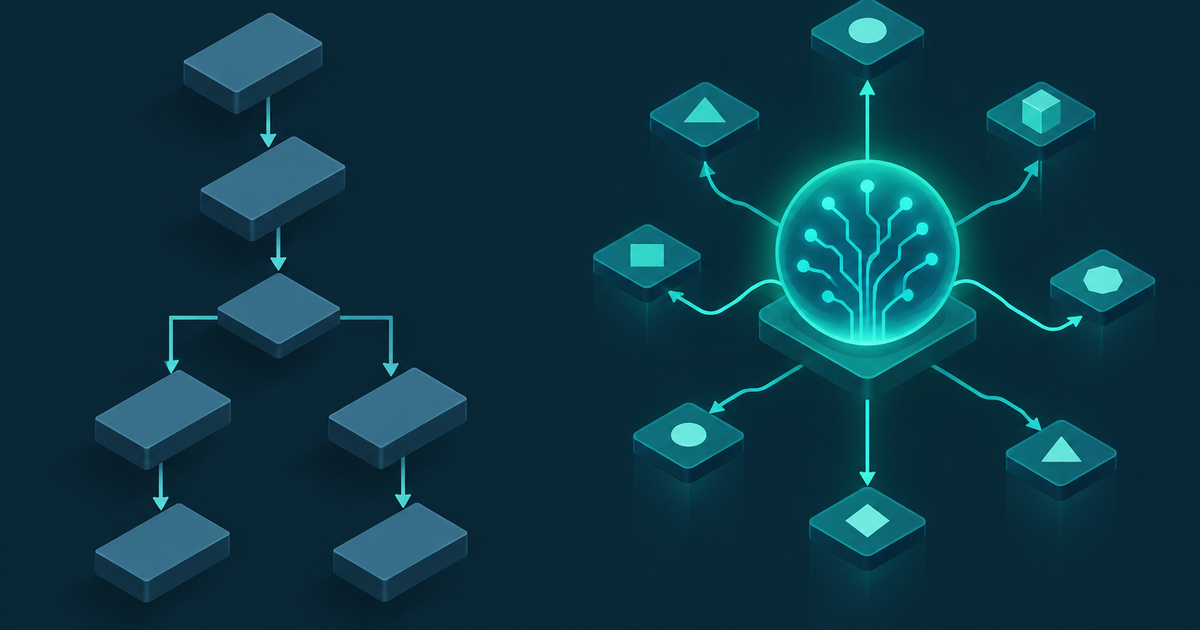
Automation follows a rule. An agent makes a decision. That's the whole difference, and it's bigger than it sounds.
Automation is a fixed set of steps. If this happens, do that. It doesn't think, and it was never built to. An AI agent works differently. It looks at a situation, weighs a few options, and chooses what to do next, inside limits you set. The job might look the same from the outside. The way it gets done is not.
Automation has been quietly running businesses for years. An email lands, it gets forwarded. A form gets submitted, a row appears in a spreadsheet. These rules are useful, and they are also completely blind. They can't tell an urgent enquiry from a spam message. They just do what they were told, every time, exactly the same way.
That rigidity is the whole point of automation. It's reliable because it never improvises. But it also means someone has to write a new rule for every situation the business runs into, and businesses run into a lot of situations rules don't cover.
McKinsey found that around 57% of current US work hours are technically automatable with tools that already exist today. Most of that work was never actually automated, because it needed a small decision, not a checklist step. A judgement call. That's the piece traditional automation was never built to handle.
An AI agent can handle it. Picture a lead filling out your website's contact form. Old-style automation drops their details into a spreadsheet and fires off a generic reply. An agent reads what they actually asked, checks if they're already a customer, works out whether this one needs a person straight away, and drafts a reply that answers their real question.
One of those needed no thought at all. The other needed several small decisions, one after another. That's a different kind of worker doing the job, not just a quicker version of automation.
Rules break the moment reality gets more varied than the rule accounted for. That's usually when a business ends up hiring someone, not to do new work, but to handle all the exceptions the automation couldn't. Answering the follow-up questions. Sorting the enquiries that didn't fit the template. Fixing the mismatch by hand.
An agent is built for exactly that. It doesn't need a new rule for every new situation. It works from a goal and a set of boundaries, and it figures out the steps in between. That's the entire reason the word "agent" replaced "automation" in so many conversations this year.
None of this means agents should run without anyone watching. The businesses getting this right give their agents a clear job, clear limits, and a person who checks the exceptions and the edge cases. The agent does the repeatable ninety percent. A person handles the ten percent that genuinely needs a human. That balance is what makes it trustworthy, not the technology alone.
If you want the fuller picture of what an AI worker actually is, separate from a chatbot or a script, we've covered that in more depth in What is an AI worker, and how is it different from a chatbot?. That's also exactly how we build every AI worker at Flowstate, with a clear job, a clear owner, and a result you can check: our AI Workers.
The old question was "what can we automate?" The better one is "what can we hand real judgement to, and where do we still want a person checking the work?" That's a different planning conversation. It's worth having before you buy anything.


.svg)





.webp)