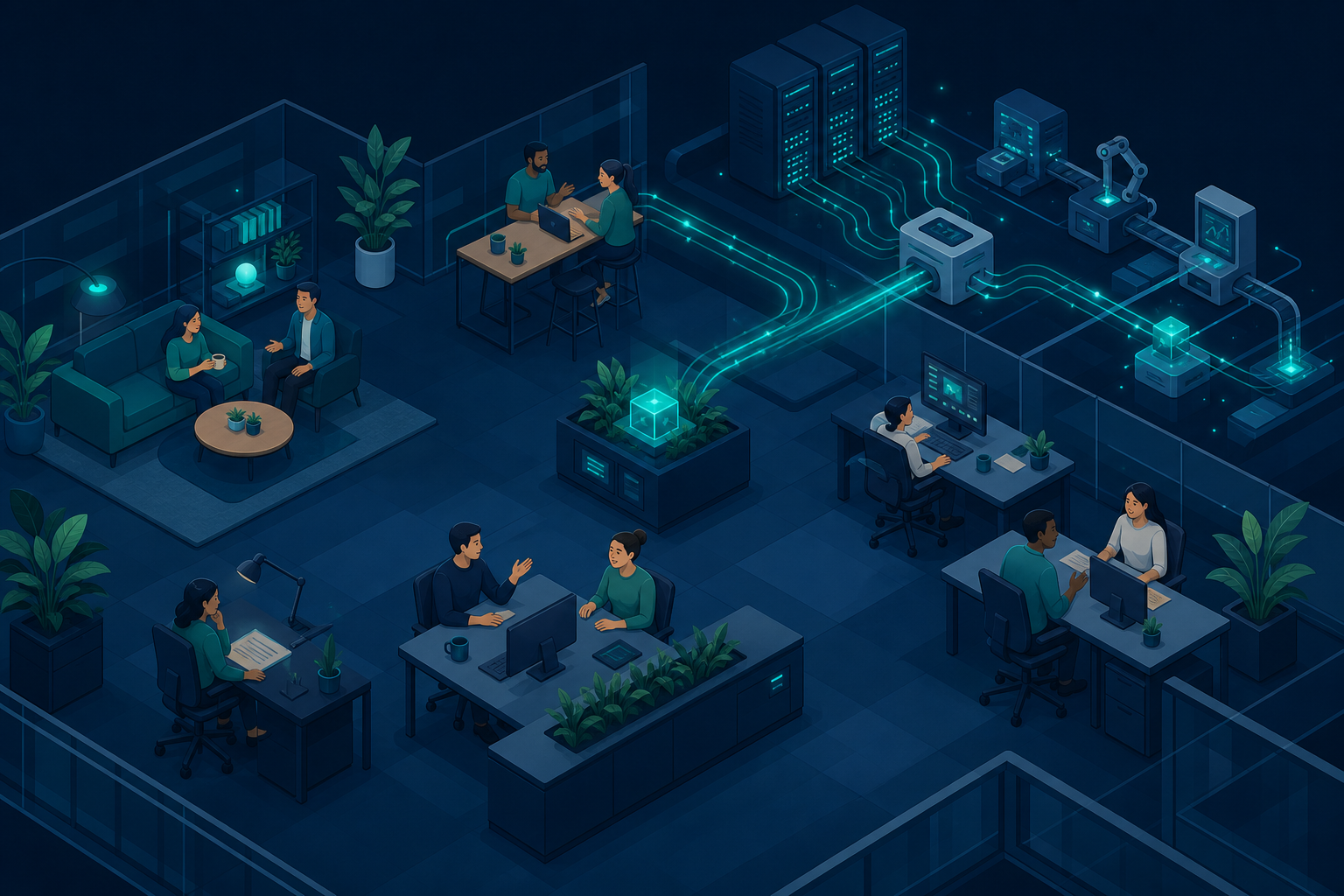
When AI transformation works, the first thing you notice is not the technology. It is your people.
They seem calmer. Less rushed. The Monday panic fades. The work still gets done, often faster, but the mood is different. That is the real marker. Not a shiny new tool. A team with room to think.
Most people picture the wrong thing when they imagine life after AI. They picture robots and empty desks. The truth is far more human than that.
Ask a leader what an AI-native business looks like and they often describe a science fiction film. Screens everywhere. Machines doing everything. People pushed to the side.
That is not what it looks like. Not even close.
Here is the reframe. AI transformation does not remove the people. It removes the parts of their job they never should have been doing.
The change is not that humans disappear. The change is that humans finally get their time back.
Picture your best account manager. Today she spends her morning updating a spreadsheet, chasing three status updates, and copying notes from one system to another.
None of that is why you hired her. You hired her for judgement. For the client call where she reads the room and saves the deal.
On the other side of transformation, the spreadsheet updates itself. The notes move on their own. She walks into the client call with everything ready. Same person. Better day. Bigger result.
That is what growth without friction feels like. Not more hours. Better hours.
This is not a feeling. It shows up in the data.
Adecco surveyed 35,000 workers in 2024. They found AI saves the average worker about one hour every day. One in five saves two hours or more.
Think about what an hour a day means across a whole team. That is not a small saving. That is a person's best thinking, handed back to them, every single day.
The point is not the hour. The point is what they do with it.
Here is the shift most leaders do not expect.
Before transformation, growth means strain. More clients means more manual work. More work means more people, more mistakes, more late nights. Growth costs you your team's energy.
After transformation, the manual work no longer scales with the business. You add clients without adding chaos. The team that felt stretched now has room. Growth stops feeling like a grind and starts feeling like momentum.
This is a pattern we see across most of the businesses we work with. The relief is not about doing less. It is about the friction finally getting out of the way.
The strange thing about the other side is how ordinary it feels.
There is no big robot moment. There is just a team spending their days on the work that matters. Real decisions. Real relationships. The things only a person can do.
Your people are your competitive advantage. On the other side of transformation, they finally spend their time like it.
That is the whole promise. Not a business run by machines. A business where your best people do their best work, because the busywork is gone.
Sit with one question. If your team got an hour back every day, what would they build with it?
That answer is the shape of your other side. The gap between it and today is exactly what transformation closes.
Ready to see what AI transformation looks like for your business?


.svg)





.webp)