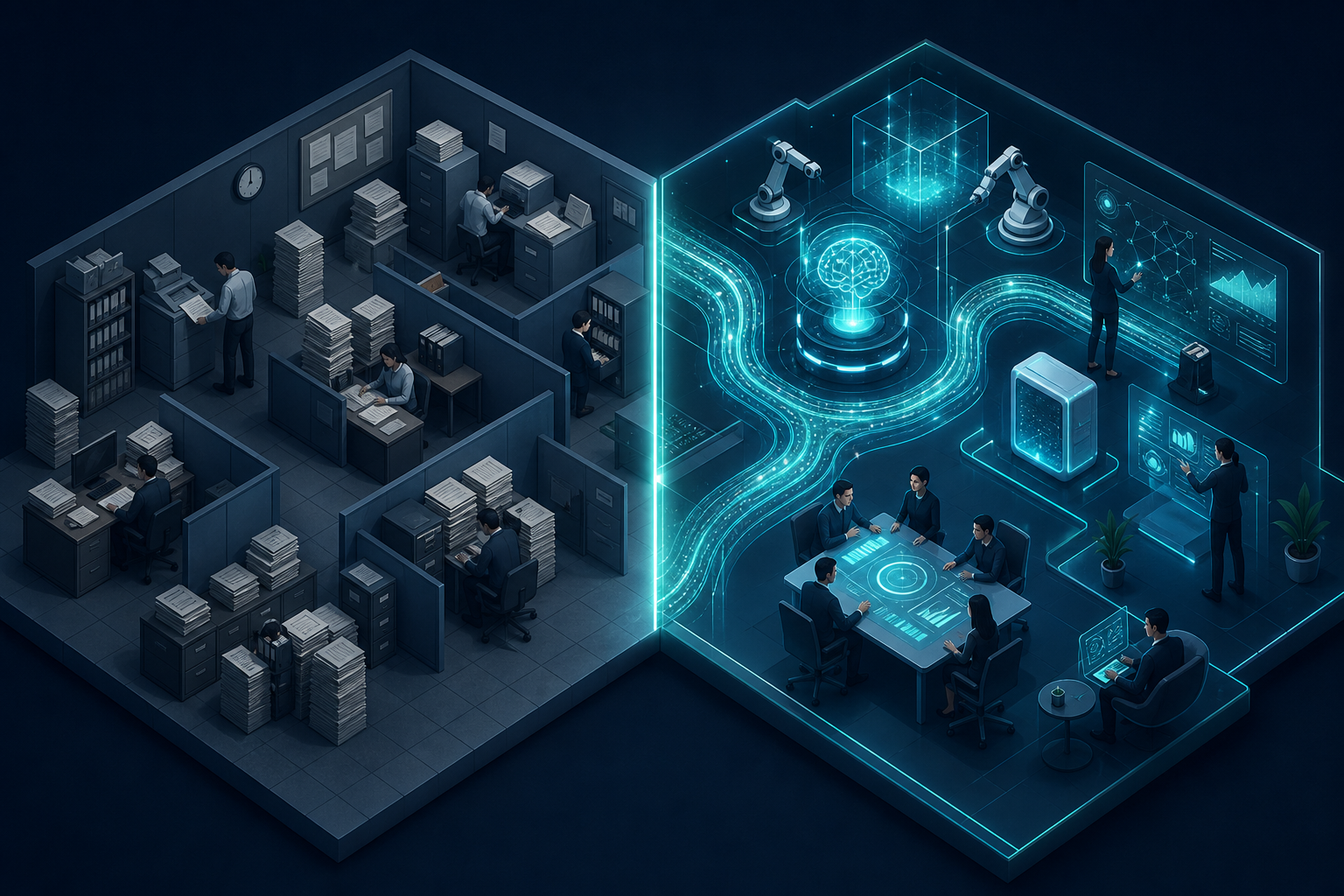
Most businesses think they are using AI. Very few are built around it. Those are not the same thing.
You can buy a tool. You can add a chatbot. You can let your team try a few prompts. None of that makes a business AI-native. It just means AI is in the building.
Here is the number that explains it. McKinsey looked at how companies use AI in 2025. They found 78% now use it in at least one part of the business. But only 6% count as high performers.
Read that again. Almost everyone is using AI. Almost nobody is getting real value from it.
That gap is the whole story. It is the difference between having AI and being AI-native.
Being AI-native is not about the tools. It is about how the work is built.
An AI-native business starts from a simple question. What should a person never have to do by hand again? Then it designs the work around the answer.
The AI is not bolted on at the end. It sits at the centre. People do the thinking. The machine does the repeating. The whole system is shaped around that split.
This isn’t a software upgrade. It’s a design choice.
Picture two companies that both “use AI.”
The first one gives staff a chatbot and hopes for the best. People use it now and then. Most of the old manual work stays exactly where it was. Reports still get built by hand. Data still gets copied between systems.
The second one looked at its work first. It found the tasks that ate the most time. It rebuilt those tasks so the machine handles them start to finish. Now the report writes itself. The data moves on its own. People only step in to decide what it means.
Same tools. Completely different outcome. One bought AI. The other became AI-native.
The first company is not lazy or behind. It did what felt sensible. It added a tool and waited for results.
But tools do not change how work flows. Only design does. If you drop AI on top of a broken process, you get a slightly faster broken process. The waste is still there. It just moves around.
That is why so many firms feel busy with AI but see no real gain. They added the technology. They never changed the shape of the work.
This is one of the most common things leaders tell us, across the hundreds of businesses we work with.
So the real test is not “are we using AI?” Almost everyone can say yes to that now.
The better test is harder. If you mapped your team’s week, how much of it is still manual work a machine could own? And what would your people do with that time if it were handed back?
Becoming AI-native is not a single purchase. It is a decision to build the work differently. The businesses that make that choice are the 6% pulling away from everyone else.
Where does yours sit?
Ready to see what AI transformation looks like for your business?


.svg)





.webp)